Though Travel de Courcey’s name may not be as widely recognized as the larger transport giants in the UK, its impact on the regional bus and coach industry cannot be understated. Over the years, the company’s innovative approaches, commitment to customer service, and strong community ties set an example for other operators—not just in the Midlands, but across the country. Despite its closure in 2020, the influence of Travel de Courcey’s way of doing business continues to inspire independent and national transport companies alike.
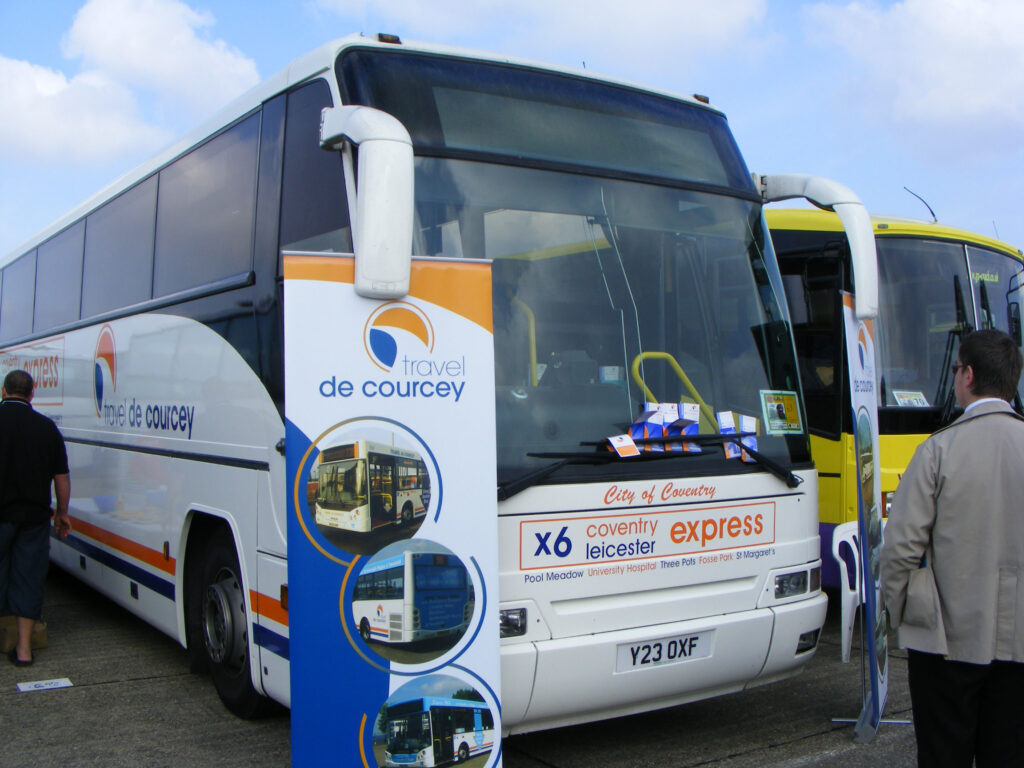
In this article, we explore how Travel de Courcey’s unique practices and values left a lasting mark on the UK transport industry.
The Rise of the Independent Operator
In an industry increasingly dominated by corporate giants, Travel de Courcey proved that independent operators could not only survive but thrive. Many smaller companies, particularly in the Midlands, took inspiration from de Courcey’s approach to business. They learned that providing high-quality, local service was a powerful tool for carving out a niche in a competitive market.
De Courcey’s commitment to serving underrepresented routes—those that major operators ignored—set a blueprint for other independents to follow. It wasn’t just about getting from point A to point B; it was about meeting the unique needs of smaller communities, rural towns, and specialized services. Independent operators saw how de Courcey managed to turn these niche routes into profitable, reliable, and respected parts of the transport network.
The ethos of putting people first—focusing on customer care, accessibility, and dependability—became a defining feature of the smaller companies that followed in de Courcey’s footsteps.
Innovation in Eco-Friendly Practices
One of the standout aspects of Travel de Courcey’s legacy was its early adoption of eco-friendly technologies. Long before environmental concerns became a mainstream conversation, the company had already begun investing in low-emission and hybrid buses. This wasn’t just a reaction to regulatory pressures—it was part of a larger vision for a sustainable and future-proof transport network.
Other UK transport operators, particularly those in urban or suburban areas, took note of de Courcey’s success with hybrid buses and low-emission vehicles. As the conversation around sustainability in transport grew louder, these companies followed suit, integrating greener fleets into their own operations. Some adopted similar hybrid technologies, while others took it a step further with full-electric vehicles.
De Courcey’s early commitment to a green transition demonstrated that it was possible to balance environmental responsibility with profitability—a crucial lesson for operators in a more eco-conscious world.
Customer Service as a Competitive Advantage
Where many national companies focused on cutting costs and streamlining operations, Travel de Courcey remained laser-focused on customer satisfaction. The company’s staff were known for their professionalism, courtesy, and personalized service. Whether it was a friendly driver who remembered your name or a customer service team that went above and beyond to help with route questions, de Courcey understood that in a world of faceless corporate transport providers, human connections mattered.
For smaller companies, this emphasis on service was a crucial differentiator. It’s easy for a big company to dismiss individual passengers, but for smaller operators trying to carve a space in the market, offering personalized, friendly service became a key competitive advantage. Many UK operators, both large and small, learned that customer loyalty is built not just through efficiency but also through the relationships forged on each journey.
Community-Focused Practices
One of Travel de Courcey’s defining features was its connection to the communities it served. The company wasn’t just a transport provider—it was part of the local fabric, sponsoring events, providing special services for schools and the elderly, and engaging in charitable activities. It understood that transport wasn’t just about moving people—it was about supporting and strengthening communities.
This commitment to community didn’t go unnoticed. Other operators began to realize that becoming a trusted part of the community was just as important as being a reliable service. Smaller and independent companies, in particular, began to adopt de Courcey’s community-first mindset. They sponsored local events, provided transport for charity runs, and even partnered with schools or local businesses to offer specialized services.
By focusing on local relationships, many operators found that they could build a loyal, dedicated customer base that went beyond just getting from one stop to the next. It was about creating a shared sense of ownership and responsibility within the communities they served.
Flexibility and Adaptability
Travel de Courcey was able to carve out a unique place in the UK transport landscape thanks to its flexibility and adaptability. While larger operators focused on standardized, high-volume routes, Travel de Courcey thrived by offering bespoke services that met specific needs. Whether it was adapting to changes in local demand, adjusting timetables, or introducing new services to meet passengers’ evolving needs, the company showed that a more agile approach could be just as effective—if not more so—than the one-size-fits-all approach of larger corporations.
For many UK transport companies, particularly smaller operators, this lesson was invaluable. It demonstrated that being flexible, listening to customers, and offering tailored services was a way to create more meaningful connections with passengers and stand out in a crowded market.
A Ripple Effect on National Operators
Even larger, national transport providers couldn’t ignore Travel de Courcey’s impact. Its commitment to eco-friendly practices and customer service was noticed by bigger players like National Express and Stagecoach, who began looking at how they could implement similar strategies on a larger scale. It wasn’t just about keeping up with the competition—it was about meeting evolving passenger expectations and positioning themselves as responsible, community-minded companies.
Some national operators took inspiration from de Courcey’s investment in hybrid buses and began to upgrade their fleets. Others observed the way the company maintained close ties to its customer base, making sure every passenger felt valued, and began to invest more in customer service training and communication.
Final Thoughts
Travel de Courcey may no longer operate in the Midlands, but its influence is still alive and well in the UK transport industry. Through its commitment to customer service, eco-friendly innovation, and community connections, the company set a benchmark for both independent and national operators. It proved that good transport isn’t just about getting from A to B—it’s about making the journey better for everyone.
For many smaller companies, Travel de Courcey was a guiding light, showing that a focus on people and service could set them apart. And for the larger players, the company’s legacy is a reminder that the best way to stay relevant is by listening to customers and staying connected to the community.
Travel de Courcey might have closed its doors, but its influence continues to echo through the UK’s transport landscape—shaping the way companies think about the future of travel.